Adrak: what changes when fresh ginger becomes dry ginger?
Fresh ginger and dry ginger come from the same rhizome. What caught my attention was how much changes during processing, before grinding even enters the picture.
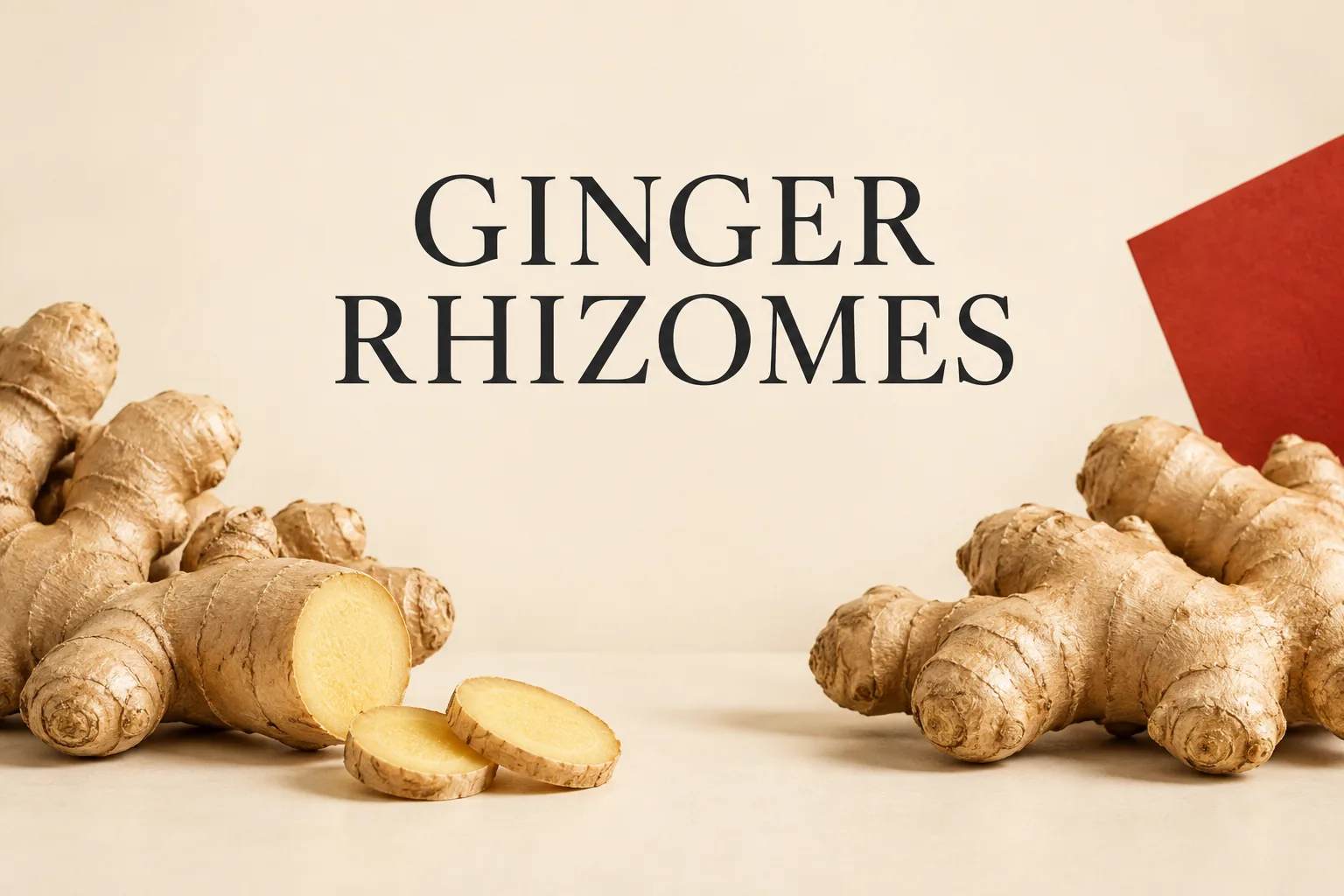
Why I looked up adrak
Seeing अदरक written out made me curious about something more specific than ginger’s familiar place in cooking: what actually changes between fresh ginger and dry ginger powder?
I kept this search to the ingredient and its processing, rather than health claims. The useful distinction turned out to be between the plant part, the drying process and the form a recipe asks for.
The main thing I learnt
The Spices Board’s ginger catalogue identifies ginger as Zingiber officinale Roscoe and its commercial part as the rhizome. It describes that underground rhizome, raw or processed, as the spice, and lists both fresh ginger and dry ginger powder among its food-processing forms.
So fresh and dried ginger are not different plants. But that does not establish that they are interchangeable spoon for spoon.
The ICAR–Indian Institute of Spices Research booklet describes peeling and sun-drying ginger to produce dry ginger. It reports dry-ginger recovery of 19–25% of fresh weight, depending on variety and climatic zone. That figure describes processing yield—not equivalent flavour in a dish.
My checklist for interpreting a ginger quantity
I put together this small checklist from those distinctions. It is a way of reading an ingredient instruction, not an official cooking guide.
| What I would check | Why it changes the decision |
|---|---|
| Does the instruction specify fresh ginger or dry ginger powder? | The Spices Board lists these as distinct forms; the shared plant name does not settle which one is intended. |
| Is the number a recipe quantity or a processing yield? | IISR’s recovery percentage concerns dried output from fresh material, not how much powder replaces fresh ginger in cooking. |
| Am I assuming that grinding is the only change? | The documented route to dry ginger includes peeling and drying before considering its powdered form. |
A hypothetical example: suppose I have 100 g of fresh ginger and see IISR’s recovery range. Applying that range gives approximately 19–25 g of dry ginger under the variety- and climatic-zone-dependent conditions described. That is an illustration of the published yield, not a prediction for my kitchen.
Now suppose a recipe asks for 100 g of fresh ginger but I only have powder. The same calculation does not establish that 19–25 g of powder is an appropriate replacement. The condition that changes the decision is the purpose of the number: production output versus recipe substitution. Neither source supplies a culinary equivalence, so I would leave that conversion unresolved rather than turn a research figure into a cooking tip.
What I looked into next
One processing detail surprised me. IISR warns that excessive peeling reduces essential-oil content because oil-bearing cells lie just below the skin.
I read that as an explanation of why peeling matters in dry-ginger production—not as a blanket instruction about how everyone should prepare fresh adrak at home. The source’s scope matters here.
My takeaway is modest but useful: knowing that two ingredients come from the same rhizome answers the identity question. It does not, by itself, answer the substitution question. I have not tested a swap; this is the distinction I could establish from the Indian primary sources.
Material checked
More to read
- Jasprit Bumrah’s 2026 T20 World Cup: which award did he win?
- Jasprit Bumrah: what do his wicket figures actually tell me?
- Looking up சாலமன் பாப்பையா: the college history behind the name
- Which ‘Chhathi Maiya’ is from The Vvaan? My song-title check
- Rekha’s Umrao Jaan: what does the restored version actually mean?